
When Your A/B Testing Tool Becomes a Malware Dispenser: The Optimizely Supply-Chain Attack
On 16 November 2026, an attacker exploited a vulnerability in Optimizely's Web Experimentation platform to inject malicious JavaScript into customer projects. Because the code was served from Optimizely's trusted CDN, it reached visitors of at least 178 organisations, including the BBC, CNN, Zoom and HSBC, with crypto clippers, card skimmers and iOS exploit kits. Optimizely says it has fixed the flaw and removed the injected code.
- Key takeaways:
- Wide reach: 188 infected snippets, belonging to 178 organisations, among 1,611 checked.
- Victims not breached: The code came from the trusted cdn.optimizely.com.
- Four payloads: Crypto swapping (about $7,040 stolen), card skimming, cookie and screenshot theft, and iOS exploits.
- Most defenses failed: Only 24 of 256 hosts (15%) had a CSP that blocked it.
- What to do now: Audit Project JavaScript, rotate tokens, tighten the CSP, and keep third-party scripts off payment pages.
- Still unknown: The entry point, the full scope, and the number of victims.
On Monday, November 16, 2026, some of the world's most visited websites served malware to their visitors. None of them had been breached. They had trusted a vendor, and the vendor's platform was turned against them.
An attacker managed to write their own JavaScript into customer projects on Optimizely's Web Experimentation platform, the service companies use for A/B testing and personalization. Report URI's Scott Helme [checked 1,611 Optimizely snippets and found 188 infected](https://blog.report-uri.com/worlds-largest-brands-infected-with-malware-via-optimizely/), belonging to 178 organizations. The list includes Zoom, the BBC, CNN, Salesforce, GitLab, IKEA, HSBC, Equifax, Air France-KLM and Ledger. Helme believes the real number is higher, because his team could only examine the snippets it found in time.
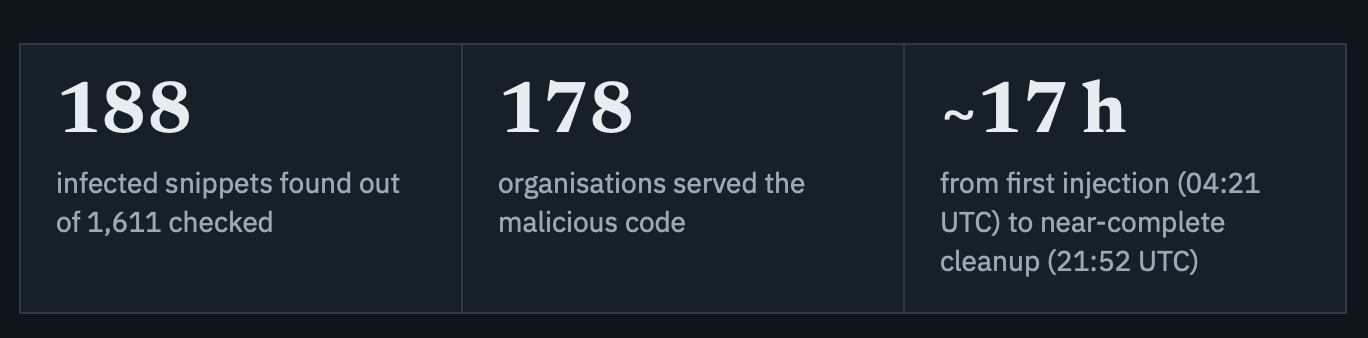
The exposure window ran roughly 17 hours, from the first injection at 04:21 UTC to 21:52 UTC, when only one of the infected snippets Report URI tracked (TalkTalk) was still serving the code. For security leaders, the lesson is less about one vendor than about how much trust a single script tag carries.
How The Attack Worked
Companies add Optimizely Web to their sites through a JavaScript snippet loaded from cdn.optimizely.com. Each snippet bundles Optimizely's code, the customer's experiments, and an optional "Project JavaScript" field where customers can add their own script. The attacker wrote a loader into that field and left the rest of each snippet untouched, so the malicious code traveled to visitors alongside the legitimate files from Optimizely's own CDN.
How the attacker got in is not settled. Socket reports a vulnerability in the account signup flow of Web Experimentation, and The Register says researchers have named it “OPTIMJACK”. Report URI says the access method is unknown and could be a compromised Optimizely system or a credential with cross-customer access. Optimizely confirmed that an unauthorized party exploited a vulnerability in Experimentation and added malicious JavaScript to some customer projects. It says it has fixed the flaw, removed the injected code, revoked tokens, and notified affected customers.
Report URI saw three loader variants:
- A plain script tag pointing to 1688360.cc/track.js, used in most snippets.
- The same URL base64-encoded and decoded with atob(), which defeats simple searches. One site was re-infected with this variant after cleanup, which shows the attacker still had access.
- A full inline copy of the payload, run through eval if the domain is blocked.
Optimizely’s own sites, optimizely.com and login.optimizely.com, were also infected.
What The Malware Did
This was not a single-purpose payload. Per Report URI, the attacker rebuilt it 26 times during the day, adding features and wallets but removing none. By the end it did four things:
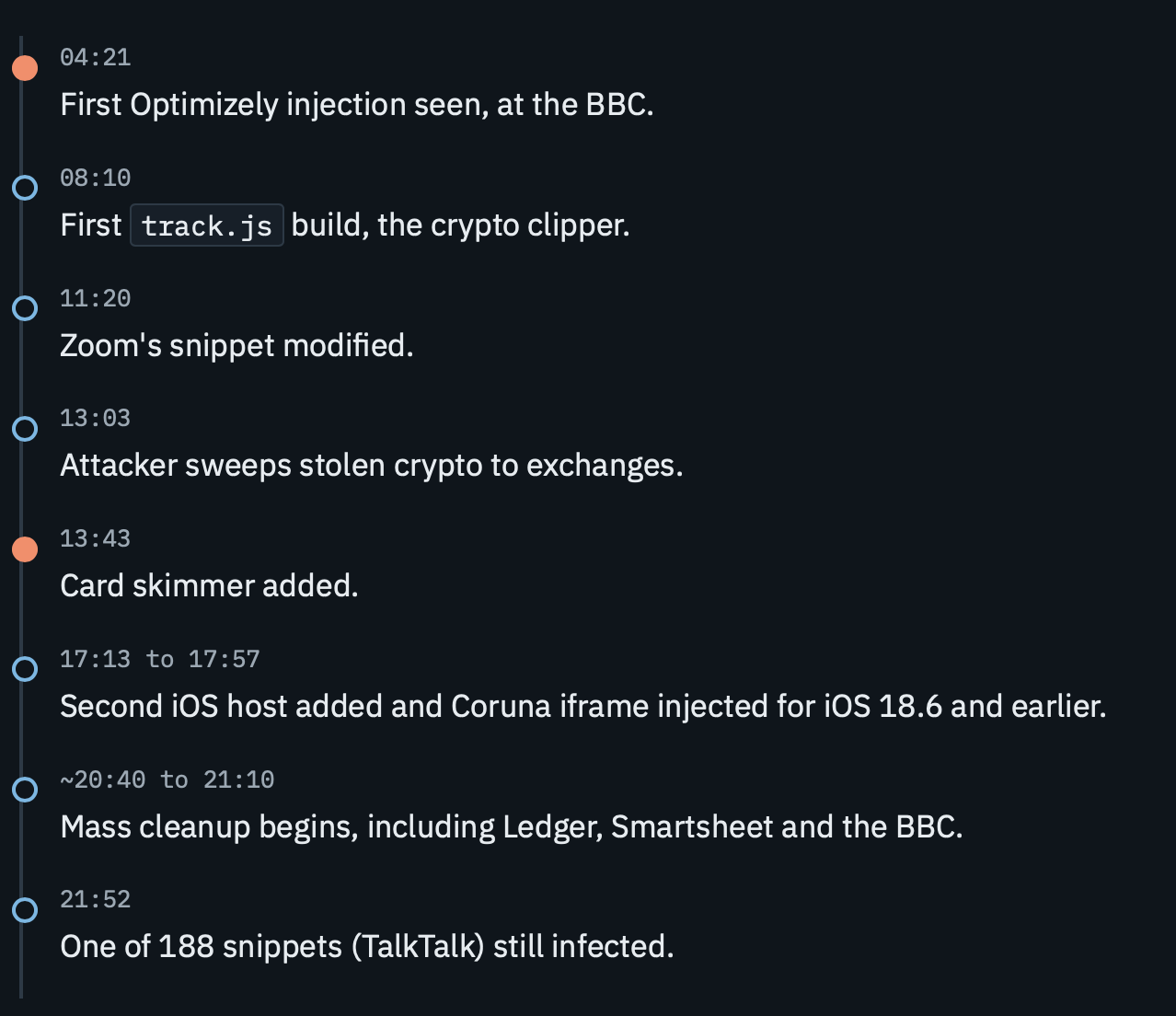
- Crypto clipper. It detects wallet addresses for BTC, EVM chains, TRON, Solana, TON, LTC, BCH and DOGE, and swaps them for attacker-controlled ones. It works on page content, form fields, the clipboard and outgoing requests. About $7,040 reached attacker wallets in roughly nine hours.
- Card skimmer. Added around 13:43 UTC, it captures Luhn-valid card numbers with expiry and CVV from forms and requests. Cards entered in hosted payment iframes, such as Stripe and Adyen, were out of reach. Cards typed into a site’s own fields were not.
- Data theft. When a swap happens near wallet or payment text, it sends the page URL, non-HttpOnly cookies and a screenshot to the attacker’s server.
- iOS exploit kits. On iPhones and iPads it loads the Coruna kit for iOS 13 to 17 and the DarkSword kit for iOS 18.x. A third chain for iOS 26 only fingerprinted the device. The kit’s own comments say iOS 18.7.3+ and 26.3+ are patched. The number of devices compromised is unknown.
The day, as Report URI reconstructed it (UTC, 16 November):
The actor is not new. Report URI traces the same injector, webshell.lol, to Turkish sites on 17 September, and to an earlier wave on 13 to 16 November that spread through other third-party scripts. The attacker’s TRON wallet has been active since March 2026.
The sector spread shows how indiscriminate the access was. Report URI counts 32 banking and finance organizations, 23 technology and SaaS, 20 retail, 12 streaming, 10 news and media, 9 airlines and travel, 8 healthcare and 7 telecoms, among others. No attacker has been named in the reporting I reviewed.
Why Most Defenses Did Not Stop It
Report URI evaluated the Content Security Policies of 256 affected hosts. Only 24 (15%) blocked the payload.
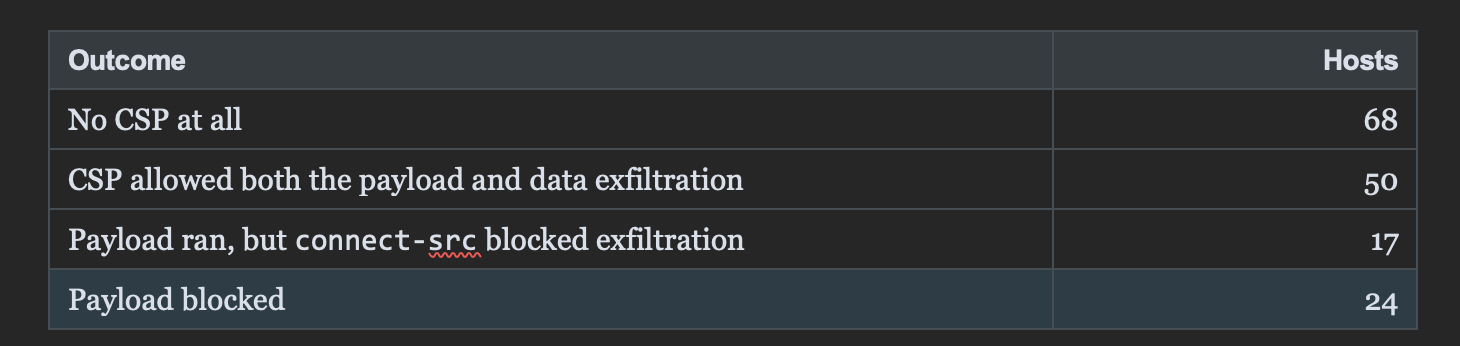
The categories do not sum to 256 in the published summary, so treat the table as Report URI’s headline findings rather than a full breakdown. Three details matter most for defenders:
- Allowlisting the vendor’s CDN gave no protection. The malicious code was served from cdn.optimizely.com, the one host every affected CSP had to trust. Only a restrictive script-src that excluded the attacker’s domain stopped the payload.
- 'strict-dynamic' and 'unsafe-eval' helped the attacker. 'strict-dynamic' trusts scripts inserted by an already-trusted snippet. 'unsafe-eval' let the inline fallback run, as it did at HSBC. Optimizely’s own documentation recommends a setting that permits eval-based execution.
- connect-src is a partial control. It blocked the theft of cards, cookies, and screenshots, but not the in-page swapping of crypto addresses.
Action Items for Security Teams
If you use Optimizely Web, work through this list first. It follows Report URI’s recommendations.
- Audit every project’s Project JavaScript and experiment custom code for 1688360.cc, atob( and unknown scripts.
- Review and rotate access for users, API tokens and integrations.
- Treat card entries on 16 November as potentially exposed if your pages have your own card fields, and consider notifying customers.
- Rotate session tokens or secrets held in non-HttpOnly cookies.
- Block the attacker domains and search page sources for the window._k7 marker.
- Deploy a CSP with a restrictive script-src and connect-src, avoid 'unsafe-eval' and 'strict-dynamic' where you can, and turn on reporting. Report-Only mode is enough to start seeing new script and data destinations.
Indicators of compromise from Report URI (attacker-owned domains; block, including subdomains):
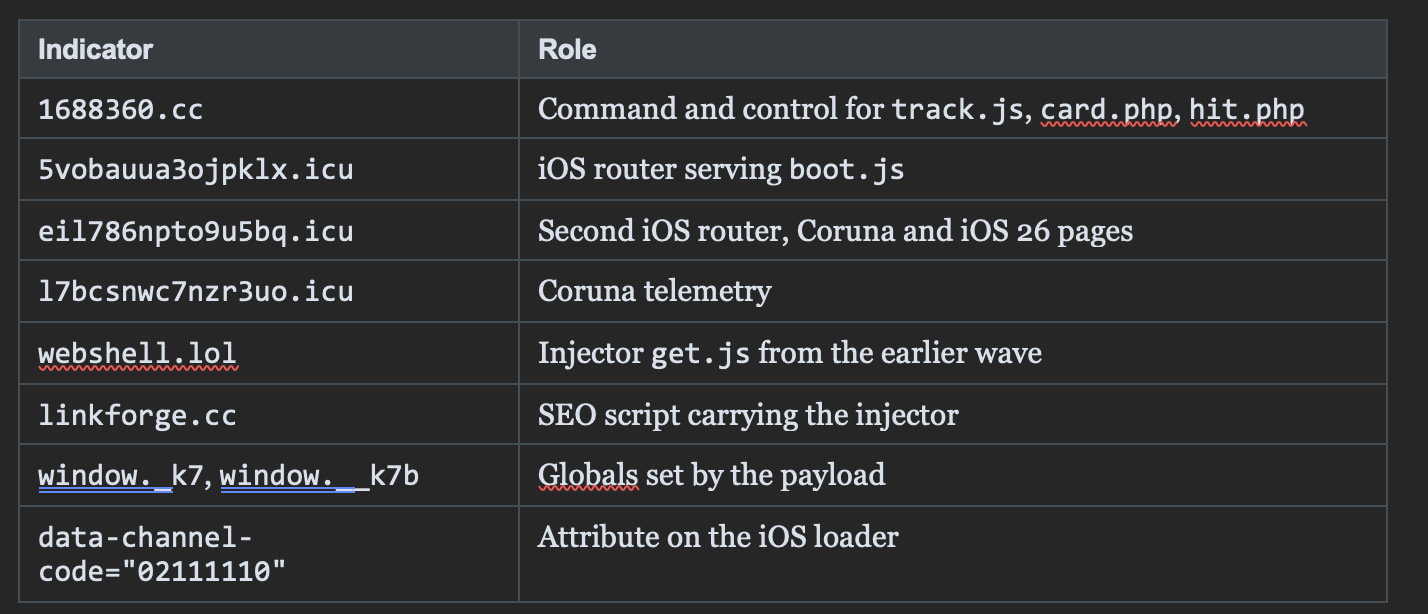
The full list, with file hashes and attacker wallet addresses, is in Report URI’s article.
Beyond this one incident, the broader questions are about governance:
- Scope. Does an experimentation or personalization script need to run site-wide? Socket advises reassessing whether it should load on payment, account, and other sensitive pages.
- Privilege. Third-party scripts run with your site’s own privileges. Treat the vendors that supply them as part of your attack surface, with the same access reviews and monitoring as internal admins.
- Detection. Monitoring for new script dependencies, new data destinations, and changes to a snippet’s fingerprint would, according to Report URI (which sells such monitoring), have flagged this on the day, independent of the vendor’s own alerting.
- Visitors. Customer-facing advice is simple: update iOS to 18.7.3 or 26.3 or later, verify crypto addresses before sending funds, and watch card statements from affected sites.
What's Still Unknown
Three questions remain open as of 18 November. The first is how the attacker gained access, since sources disagree on whether it was a signup-flow flaw or an unconfirmed access route. The second is the true scope: 178 organizations is the number Report URI could observe, and it may be a floor. The third is the damage, since the number of cards, cookies, and iOS devices compromised is unknown. The figure of about $7,040 stolen covers only the crypto clipper over roughly nine hours.
This incident is separate from Optimizely’s February 2026 vishing breach, which UpGuard attributes to ShinyHunters and which exposed basic business contact information. Nothing in the sources I reviewed links the two.
The takeaway for CISOs is that a vendor’s script is your code. Whatever it can read on your pages, an attacker who reaches the vendor can read too.